hydraulic grading buckets: Rigid or hydraulic?
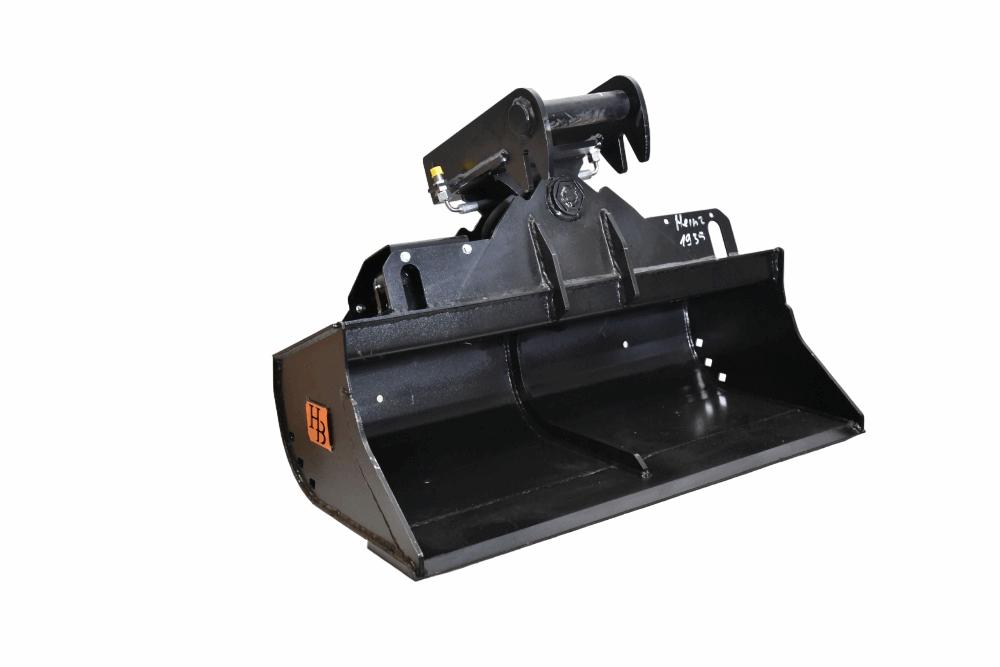
A hydraulic grading bucket is a wide excavator bucket that is primarily used for clearing, leveling, grading, and profiling surfaces. It is often used in civil engineering, road construction, and landscape gardening.
Generally, there are rigid hydraulic grading buckets and hydraulically swiveling hydraulic grading buckets. Both variants have their merits – which one is more suitable depends on the planned work.
→ View hydraulic grading buckets | → View rigid hydraulic grading buckets
What is a hydraulic grading bucket?
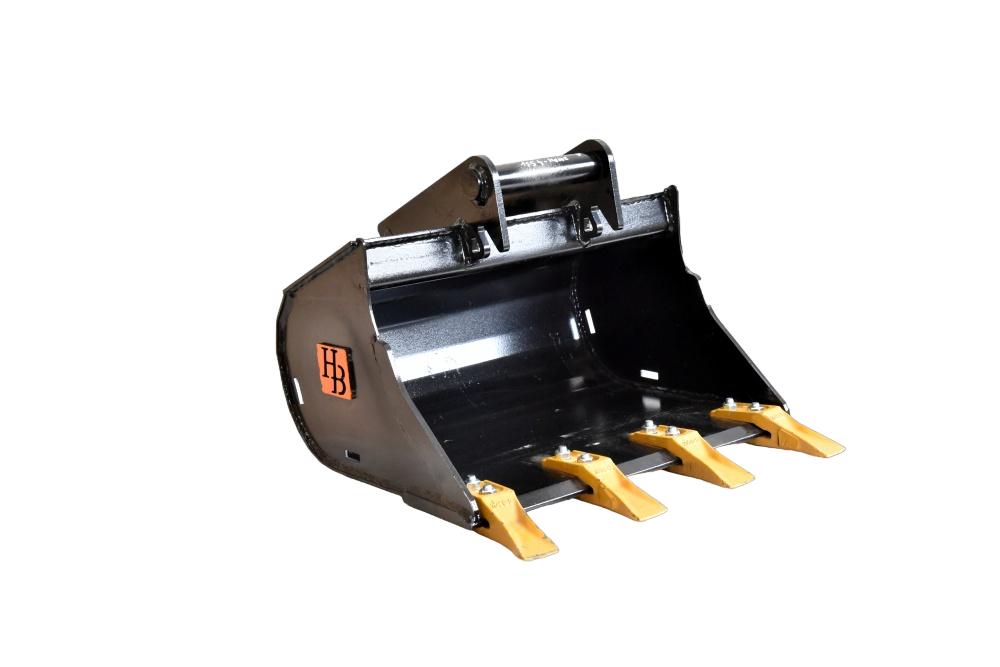
A hydraulic grading bucket differs from a classic digging bucket mainly due to its usually significantly greater working width and its shape designed for clearing and leveling work.
While a digging bucket is primarily used for digging, loosening, and picking up material, a hydraulic grading bucket is particularly suitable for tasks where larger areas need to be worked on or material needs to be distributed and graded.
What is a hydraulic grading bucket used for?
Due to its wide design, a hydraulic grading bucket can be used for various tasks.
- Clearing ditches: For cleaning and finishing already excavated ditches.
- Leveling surfaces: For distributing and grading soil and other suitable materials.
- Profiling embankments: For creating and finishing sloped surfaces.
- Modeling terrain: For example, in landscape gardening.
- Ditch and watercourse maintenance: Depending on the design and operating conditions, for clearing suitable areas.
What is a hydraulic grading bucket?
A hydraulic grading bucket, often also called a tilt bucket, can be swiveled or tilted sideways using the excavator's hydraulics.
This allows the working angle of the bucket to be changed without having to adjust the position of the entire excavator.
The possible swivel angle depends on the specific design and execution of the hydraulic grading bucket.
→ Discover hydraulic grading buckets
What are the advantages of a hydraulic grading bucket?
The swiveling function offers additional possibilities, especially for work with different angles.
- Adjustable working angle: The bucket can be hydraulically adapted to different inclinations.
- Good for embankments: Sloping surfaces can be worked on more flexibly.
- Flexible leveling: Uneven or differently sloped surfaces can be worked on from various working positions.
- Less repositioning required: Depending on the construction site situation, the swivel function can help reach work areas without repositioning the excavator for every angle change.
What is a rigid hydraulic grading bucket?
With a rigid hydraulic grading bucket, the bucket body is rigidly connected to the adapter. There is no hydraulic swivel function.
This results in a simpler construction. Rigid hydraulic grading buckets are particularly suitable for tasks where no lateral angle adjustment of the bucket is required.
→ Discover rigid hydraulic grading buckets
What are the advantages of a rigid hydraulic grading bucket?
- Simple construction: No hydraulic components are needed for a swivel function.
- Good for flat surfaces: For classic clearing, distributing, and leveling work, a rigid design can be perfectly sufficient.
- No additional swivel hydraulics: No hydraulic cylinders or corresponding lines need to be operated on the bucket for angle adjustment.
- Price: Due to their simpler construction, rigid versions are often cheaper than comparable hydraulically swiveling models.
Rigid or hydraulic grading bucket – which is better?
There is no inherently "better" hydraulic grading bucket. The decisive factor is what tasks are to be primarily performed.
If you mainly clear, distribute, or level straight surfaces and do not require lateral angle adjustment, a rigid hydraulic grading bucket may be the right choice.
If, however, you regularly work on embankments, different terrain slopes, or require various working angles, a hydraulic grading bucket offers additional flexibility.
Rigid vs. hydraulic in direct comparison
| Feature | Rigid | Hydraulic |
|---|---|---|
| Swivel function | No | Yes |
| Straight leveling work | Well suited | Well suited |
| Embankments / Slopes | Excavator position critical | More flexible due to swivel function |
| Hydraulics on the bucket | Not required | Required |
| Construction | Simpler | Additional swivel components |
| Typical use | Clearing and leveling | Clearing, leveling, and profiling with changing angles |
Which hydraulic grading bucket fits my excavator?
In addition to the decision between rigid and hydraulic, width, weight, adapter, and excavator size must be considered.
Particularly important is the existing excavator adapter. The adapter cannot always be reliably determined solely by the excavator manufacturer or model.
If you do not know which adapter is installed on your excavator, you can use our adapter finder:
→ Determine excavator adapter with the adapter finder
Further information can be found in our guide:
→ Which excavator adapter do I have?
Why are width and weight important?
hydraulic grading buckets often have a greater working width than classic digging buckets due to their intended use. With increasing size, their dead weight and the volume of material they can hold can also increase.
The selected bucket must therefore match the machine and the intended use. For hydraulic models, components for the swivel function are also added.
You can find out more about bucket weight here:
→ How much does an excavator bucket weigh?
Digging bucket or hydraulic grading bucket?
A digging bucket is particularly suitable for digging, loosening, and picking up material. The wider hydraulic grading bucket, on the other hand, is designed for clearing, leveling, and profiling work.
On many construction sites, both types of buckets complement each other: the digging bucket is first used to excavate, and then the hydraulic grading bucket is used to distribute, grade, or profile the material.
What should I look for when buying?
Before buying a hydraulic grading bucket, the following points should be checked in particular:
- suitable excavator adapter or quick coupler
- excavator size and machine configuration
- dead weight of the hydraulic grading bucket
- suitable working width
- rigid or hydraulic
- for hydraulic versions, the required hydraulic connections
- planned area of use
The technical data of the excavator and the respective attachment should be compared before use.
Conclusion: Rigid or hydraulic depends on the application
A rigid hydraulic grading bucket is a good choice for classic clearing and leveling work when no additional angle adjustment is required.
A hydraulic grading bucket offers additional flexibility due to its swivel function and is particularly interesting when embankments, slopes, or different working angles are regularly handled.
Ultimately, the decisive factors are application area, excavator size, weight, width, and the suitable adapter.
→ View hydraulic grading buckets | → View rigid hydraulic grading buckets
Don't know your adapter yet? Use our adapter finder or send us photos and dimensions of your existing adapter.