What types of excavator buckets are there?
There are different types of excavator buckets and excavator shovels for excavators and mini excavators. The right bucket depends on whether you want to dig, level, sieve material, or create a narrow trench, for example.
Common bucket types include hydraulic grading buckets, grading buckets, screening buckets, cable buckets, and clay buckets. Additionally, there are other excavator attachments such as rippers or root rakes for special jobs.
In this guide, we show the most important differences and explain which excavator bucket is suitable for which job.
What types of excavator buckets are there?
The different excavator buckets vary in shape, width, volume, design, and intended use. An overview of the most important variations:
- hydraulic grading bucket: for digging and excavation work
- Fixed grading bucket: for clearing and leveling work
- Hydraulic grading bucket: for clearing, leveling, and profiling work with adjustable working angle
- screening bucket: for separating and sorting suitable materials
- Cable bucket: for particularly narrow trenches
- Clay bucket: for narrow digging and earthmoving work
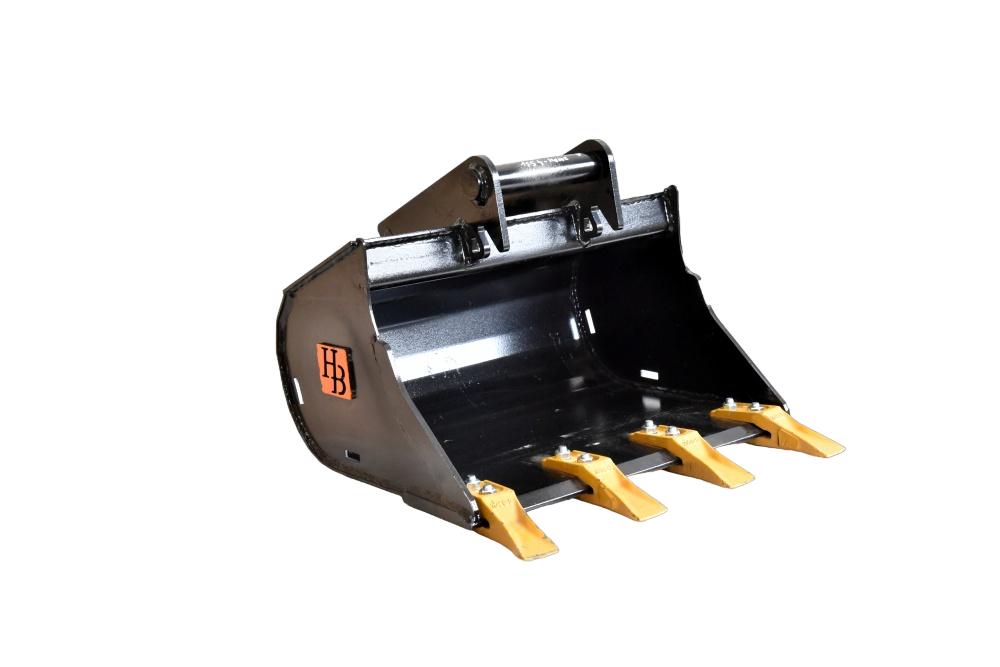
1. hydraulic grading bucket – for classic digging and excavation work
The hydraulic grading bucket is designed for classic earthmoving and digging work. It can be used to loosen, pick up, and move suitable soils and materials.
Typical jobs include:
- Digging trenches
- Excavation for foundations
- General earthworks
- Gardening and landscaping
- Picking up and moving suitable materials
hydraulic grading buckets are available in different widths and designs. Depending on the intended use, narrower or wider variants, as well as buckets with teeth, may be useful.
→ View hydraulic grading buckets for excavators & mini excavators
→ Guide: What is a hydraulic grading bucket?
2. Fixed grading bucket – for clearing and leveling
A fixed grading bucket is usually significantly wider than a classic hydraulic grading bucket. It is particularly used when larger areas need to be worked on, material needs to be distributed, or areas need to be stripped.
Typical applications include:
- Leveling surfaces
- Distributing and stripping material
- Clearing trenches
- Terrain modeling
- Simple profiling work
Since there is no hydraulic swivel function, the bucket body is firmly connected to the attachment.
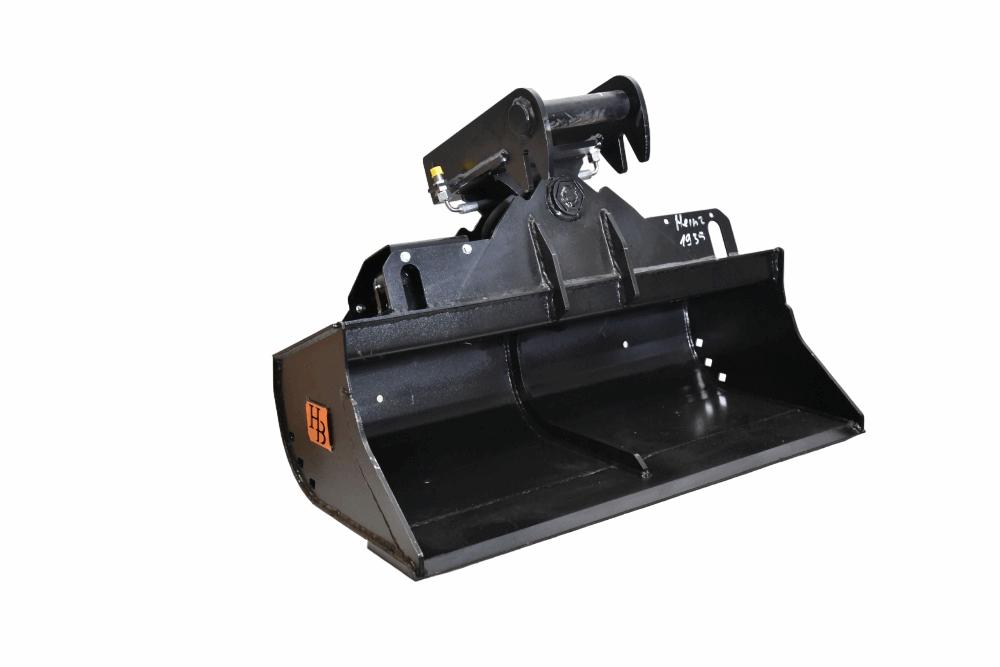
3. Hydraulic grading bucket – flexibly pivotable
A hydraulic grading bucket, often also called a tilt bucket, can be tilted or pivoted sideways via the excavator's hydraulics.
This allows the working angle to be changed. This is particularly practical for slopes, varying terrain gradients, and profiling work.
Typical applications include:
- Leveling and stripping
- Profiling slopes
- Working on inclined surfaces
- Terrain modeling
- Clearing and finishing trenches
→ View hydraulic grading buckets
→ Comparison: Fixed or hydraulic grading bucket?
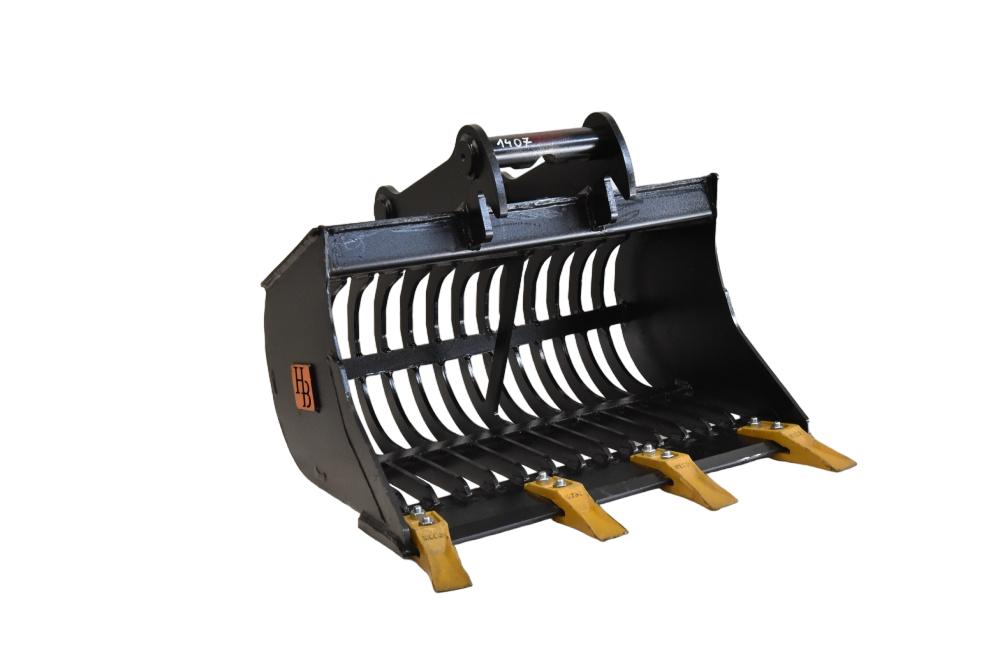
4. screening bucket – for separating and sorting material
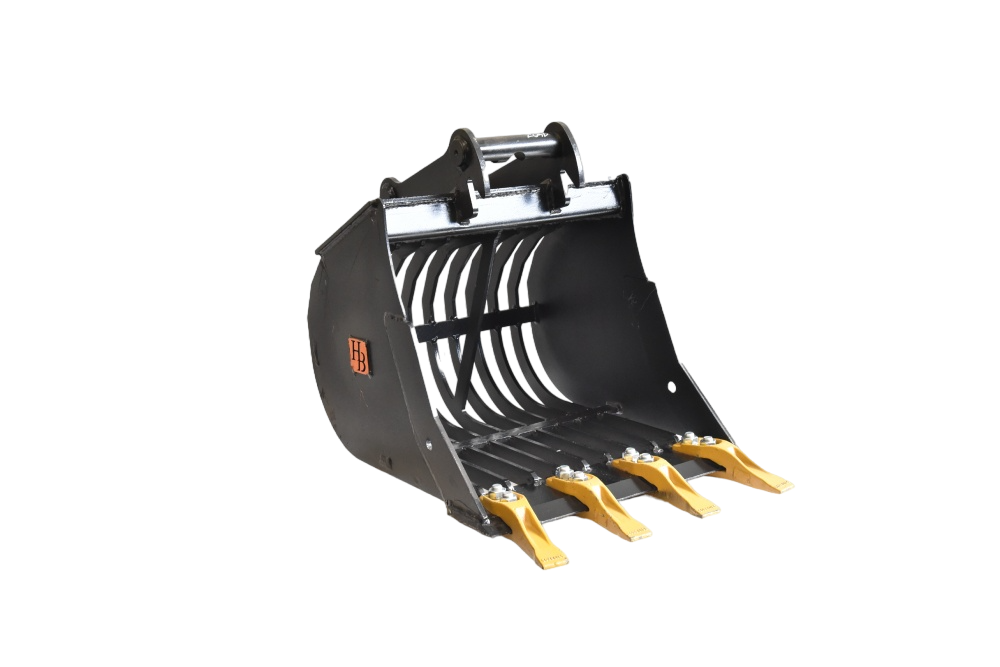
A screening bucket differs from a classic hydraulic grading bucket due to its open construction. Smaller components can fall through the gaps, while larger components remain in the bucket.
Depending on the design and material, it is suitable, for example, for:
- Sieving earth and topsoil
- Sorting out larger stones
- Separating suitable materials
- Processing soil
- Pre-sorting suitable demolition materials
The result achieved depends, among other things, on the spacing of the sieve elements and the material to be processed.
→ View screening buckets for excavators
→ Guide: When do I use a screening bucket?
5. Cable bucket – for particularly narrow trenches
A cable bucket is a narrow excavator bucket for work where the narrowest possible trenches are to be made.
It can be used, for example, for certain work involving cables, pipes, or other narrow routes.
Due to the small working width, less soil has to be excavated compared to a significantly wider bucket, if only a narrow trench is required for the respective work.
6. Clay bucket – narrow design for digging and earthmoving work
Clay buckets also belong to the special bucket types. They have a comparatively narrow design and are used for corresponding digging and earthmoving work.
Which design is useful depends on the soil, desired trench width, excavator size, and the respective task.
Which excavator bucket do I need for which job?
| Job | Typical Excavator Bucket |
|---|---|
| Digging / Excavation | hydraulic grading bucket |
| Narrow Trench | Cable bucket / narrow hydraulic grading bucket |
| Leveling / Stripping | Grading bucket |
| Slopes / changing angles | Hydraulic grading bucket |
| Sieving earth / material | screening bucket |
| Special narrow earthmoving work | Clay bucket |
Not every excavator job requires an excavator bucket
In addition to various excavator buckets, there are other attachments for excavators and mini excavators that are designed for special tasks.
A ripper, for example, can be used to break up and loosen suitable hard or compacted materials. A root rake, on the other hand, is suitable for corresponding clearing, sorting, and grubbing work.
→ View rippers | → View root rakes
What size should my excavator bucket be?
The correct size depends not only on the weight of the excavator. Key factors include intended use, working width, bucket volume, dead weight, and machine configuration.
A bucket that is as large or wide as possible is not automatically the best choice. The bucket and machine must be technically compatible.
You can find out more about the weight of excavator buckets here:
→ How much does an excavator bucket weigh?
Which hitch does my excavator bucket need?
In addition to the bucket type and size, the correct excavator hitch is crucial. The bucket must match the existing hitch or quick coupler of the excavator.
The hitch cannot always be reliably determined solely by excavator manufacturer, model, or machine weight.
If you don't know your hitch, you can use our hitch finder:
→ Determine excavator hitch with the hitch finder
Further information can be found in our guides:
- Which excavator hitch do I have?
- What excavator bucket hitches are there?
- MS01, MS03, MS08, MS10 & MS21 – Dimensions and Differences
- CW05, CW10, CW20, CW30 & CW40 – Dimensions and Differences
How do I find the right excavator bucket?
To make your selection, you should first determine what work needs to be done. Then, the bucket type, width, weight, and hitch can be selected.
Simply put: Dig with the hydraulic grading bucket, level with the grading bucket, separate material with the screening bucket, and create particularly narrow trenches with a correspondingly narrow bucket.
Then it must be checked whether the selected attachment technically fits the machine and the existing hitch.
Conclusion: The right excavator bucket for every job
Which excavator bucket is the right one depends primarily on the planned use. hydraulic grading buckets are suitable for classic digging and excavation work, grading buckets for clearing and leveling work, and screening buckets for separating and sorting suitable materials.
Further bucket types and attachments are available for special tasks.
Especially important, in addition to the correct bucket type, is the matching hitch for your excavator.
→ View hydraulic grading buckets | → View screening buckets | → View hydraulic grading buckets
Don't know your hitch yet? Use our Hitch Finder or send us photos and measurements of your existing hitch.