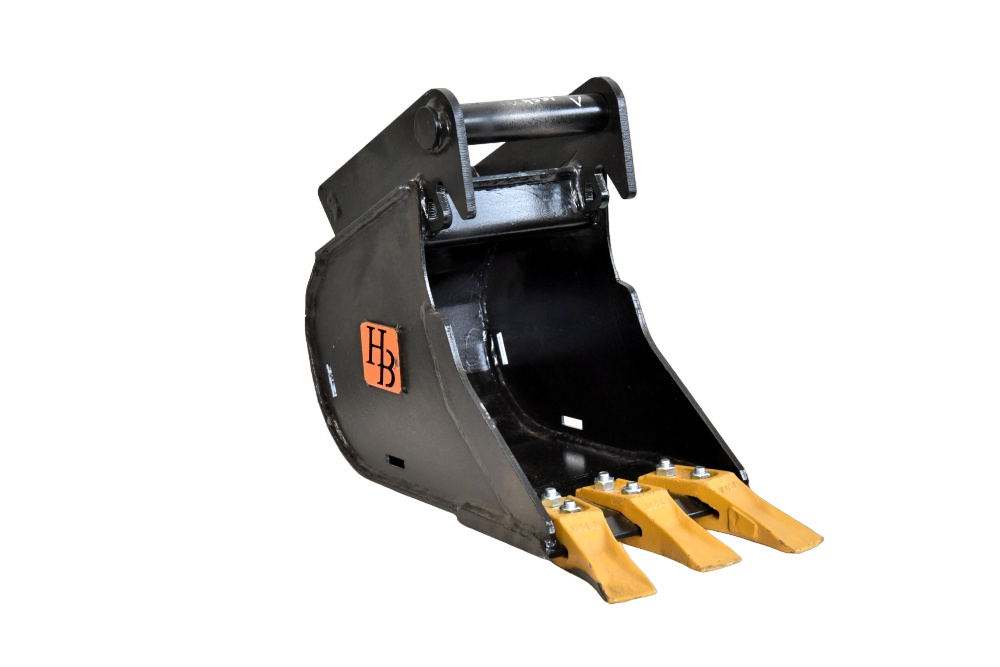

Hydraulic Grading Bucket – Function, Application, and Selection
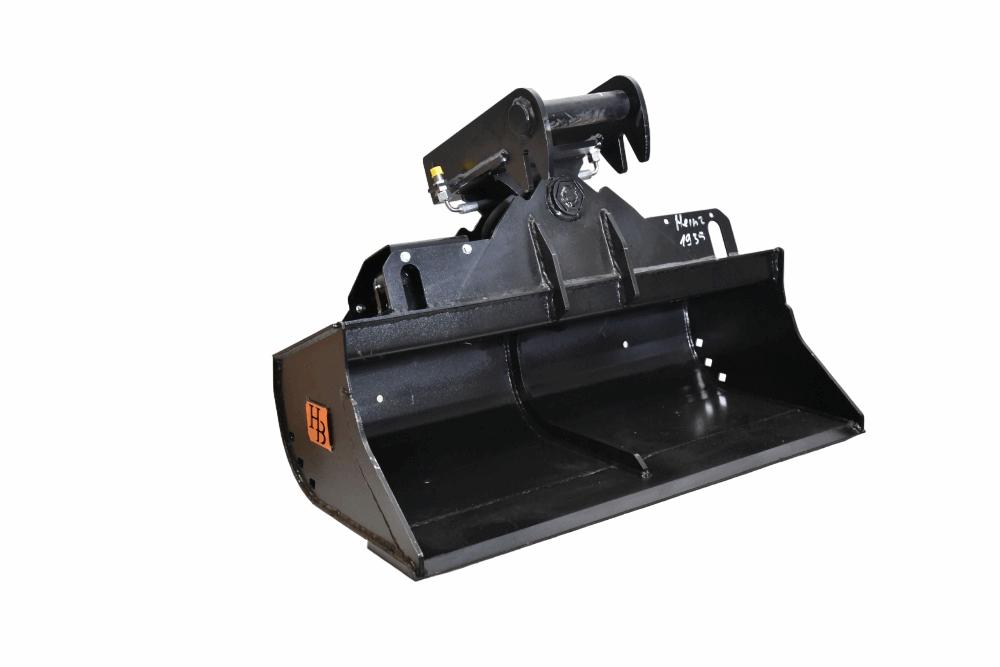
A hydraulic grading bucket, often also referred to as a tilt bucket, is an excavator bucket used for clearing, grading, and profiling work. Unlike a rigid grading bucket, the blade can be hydraulically tilted sideways.
This allows the working angle of the bucket to be adjusted to different ground slopes. This is helpful, for example, when grading surfaces, profiling slopes, or clearing trenches.
→ View Hydraulic Grading Buckets
What is a hydraulic grading bucket?
Compared to many classic digging buckets, a grading bucket has a wide design and is primarily used for corresponding clearing, grading, and profiling work.
The hydraulic version also features a swivel function. The angle of the bucket can be adjusted within the structurally defined swivel range using the excavator's hydraulics.
The exact swivel angle depends on the specific design of the grading bucket and should be taken from the technical data of the respective product.
How does a hydraulic grading bucket work?
The swivel mechanism allows for a lateral movement of the bucket. For this to work, the hydraulic function of the attachment must be connected to the machine and controllable from the excavator.
This additional range of motion means that not every angle change has to be achieved solely through the excavator's position or its boom.
Especially on sloped or uneven surfaces, the swivel function can therefore offer additional possibilities for positioning the bucket.
What is a hydraulic grading bucket used for?
Hydraulic grading buckets can be used for various earthmoving, landscaping, and clearing tasks.
Typical applications include:
- Grading and leveling surfaces
- Profiling slopes
- Clearing and finishing trenches
- Terrain modeling
- Gardening and landscaping
- Working on sloped surfaces
- Certain civil engineering and earthmoving tasks
Hydraulic grading bucket for slopes
A common application is working on slopes. The swivel function allows the bucket angle to be adapted to the respective incline.
This can be helpful when profiling and grading sloped surfaces. However, the required slope shape and incline depend on the respective soil and construction site conditions.
Detailed information on this can be found in our guide:
→ How to properly create a slope – incline, drainage & tools
What are the advantages of the hydraulic swivel function?
The decisive difference to a rigid grading bucket is the additional adjustment option for the bucket angle.
Depending on the work situation, this can result in the following advantages:
- Adjustable working angle for sloped surfaces
- More flexible positioning of the bucket
- Practical for slope and profiling work
- Suitable for various clearing and grading tasks
- Additional range of motion compared to a rigid bucket
Whether a hydraulic or rigid grading bucket is the better choice depends on the specific application.
→ Grading bucket: Rigid or hydraulic?
Hydraulic or rigid grading bucket?
A rigid grading bucket does not have its own hydraulic swivel function. The working angle is therefore more strongly determined by the position and movement of the excavator.
With a hydraulic grading bucket, the bucket angle can also be hydraulically adjusted. This offers more possibilities, especially with changing inclinations and profiling work.
For predominantly straight clearing and grading work, however, a rigid grading bucket can also be a suitable solution.
What width should a hydraulic grading bucket have?
The appropriate width depends on the excavator, the task, and the desired area performance. A wider grading bucket processes a larger area with one work movement, but usually also has a correspondingly different dead weight and volume.
Therefore, the width should not be considered in isolation. Bucket width, weight, mounting system, and machine configuration must match.
More on bucket weight:
→ How much does an excavator bucket weigh?
What type of hitch do I need for a hydraulic grading bucket?
The grading bucket must be compatible with the existing excavator hitch or quick coupler. The hitch should therefore be clearly determined before ordering.
Excavator manufacturer, model, or machine weight alone are not always sufficient.
If you are unsure about your hitch, use our hitch finder:
→ Determine excavator hitch with the hitch finder
Further information on hitch systems:
- Which excavator hitch do I have?
- MS01, MS03, MS08, MS10 & MS21 – Dimensions & Differences
- CW05, CW10, CW20, CW30 & CW40 – Dimensions & Differences
What hydraulics are needed for a tilt bucket?
For the swivel function to be usable, the excavator must have a suitable hydraulic supply and control system for the attachment.
Which connections, lines, and hydraulic requirements are needed depends on the excavator and the design of the grading bucket. The technical requirements should therefore be checked before ordering.
Greater reach with a boom extension
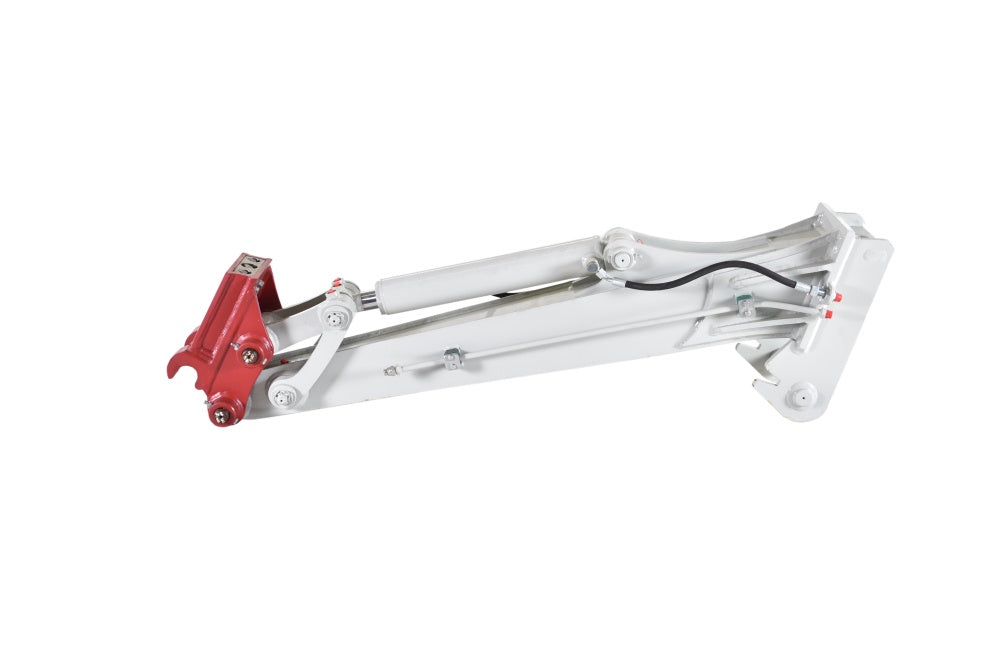
For certain slope, trench, or profiling work, additional reach may be required. For suitable applications, a boom extension can be used.
It must be considered that the additional length changes the leverage of the excavator. Therefore, the excavator, boom extension, and the attachment used must be technically compatible.
→ Boom Extension for Excavators – Use, Reach & Selection
What should you look for when buying?
Before purchasing a hydraulic grading bucket, the following points should be checked in particular:
- Matching hitch or quick coupler system
- Technical suitability for the excavator
- Bucket width
- Bucket's own weight
- Required swivel range
- Available hydraulic connections and controls
- Intended use
Maintenance and inspection of a hydraulic grading bucket
In addition to the general wear points of an excavator bucket, the components of the swivel function on a hydraulic grading bucket should also be regularly inspected according to the specifications of the respective product.
This may include hydraulic lines, connections, bearings, and other movable components.
Damaged or conspicuous components should be professionally checked before further use.
Conclusion: Flexible working angle through hydraulic swivel function
A hydraulic grading bucket combines the wide design of a grading bucket with a hydraulic swivel function. This allows the working angle to be adapted to different terrain shapes and work situations.
This additional range of motion can be particularly useful for slope, clearing, grading, and profiling work.
Crucial for selection are the matching hitch, bucket width, weight, hydraulic requirements, and technical suitability for the respective excavator.
→ View Hydraulic Grading Buckets
Are you unsure about the hitch or version? Use our hitch finder or contact us.